

Last verified: August 2026
Fixed hours. Your equipment. Your management. No other clients. Two years of invoices for
the same monthly amount. That is the profile of contractor misclassification almost
everywhere we operate — an employment relationship wearing a supplier invoice, and the
most common way remote-first companies expose themselves to risk without realising it.
Every country’s misclassification test looks different on paper. Underneath, most of them
ask the same handful of questions, and most foreign employers only learn what those
questions are after someone has already asked them.
The one question every authority asks: who controls the work?
The label on a contract, or the fact that someone invoices you instead of appearing on
payroll, doesn’t settle the question anywhere we operate. Spanish inspectors, the Dutch tax
authority, Brazilian labour courts, Polish ZUS and Indian labour commissioners all start from
the same place: not what the paperwork calls the relationship, but how it actually functions
day to day.
Picture a support engineer paid the same amount every month for two years, working your
ticket queue during your hours, on a laptop you issued, logged into your helpdesk under your
domain, with no other clients. Reprint the invoice with “independent contractor” across the
top and nothing about the underlying relationship changes. If you set the hours, supply the
equipment, direct how the work gets done, and the person has no other clients, the label on
the invoice doesn’t decide anything. Local authorities look at how the relationship actually
works, not at what it was called when it was set up. A contract that says “independent
contractor” carries no more weight than a contract that says “at-will employee” in a country
that doesn’t recognise at-will employment — the words on the page don’t override the facts
on the ground.
The five factors that show up in almost every jurisdiction’s test
Strip away the local vocabulary and almost every misclassification test in almost every
country is checking the same five things.
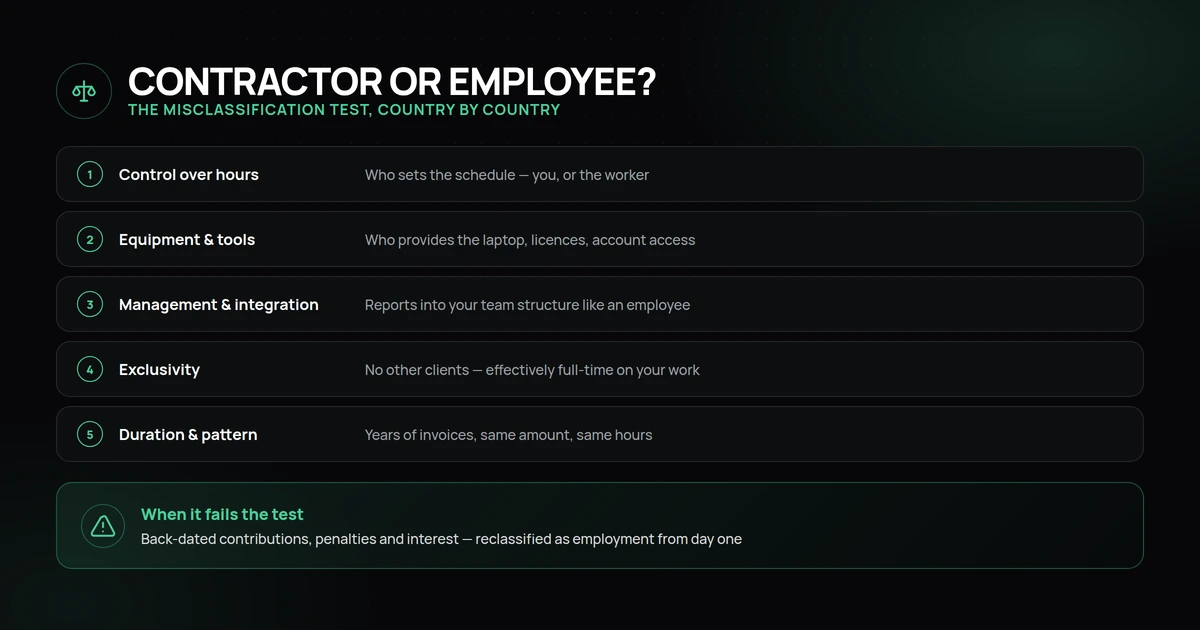
| Factor | What it looks like when it points to employment |
|---|---|
| Control over hours | You set the schedule, not the worker |
| Equipment and tools | You provide the laptop, the software licences, the account access |
| Management and integration | The person reports into your team structure like any other employee |
| Exclusivity | No other clients — effectively full-time on your work |
| Duration and pattern | Years of invoices for the same amount, the same hours, the same work |
No single factor is usually decisive on its own. A freelancer might use your Slack workspace
and still be a genuine contractor if they also work for three other clients and set their own
hours. It’s the pattern across all five that authorities weigh, and the pattern that gives
foreign employers away: a relationship that has looked identical, month after month, for
years, with one client, on that client’s schedule, using that client’s equipment.
It’s also worth noticing what isn’t on the list. The currency the invoice is paid in, the
platform used to send it, and the fact that both sides signed a document calling it a
“services agreement” appear nowhere in any of the five factors above. Companies that get
this wrong tend to have spent real effort on the paperwork — a properly worded contract, a
statement of work, a defined scope — while the day-to-day relationship kept running exactly
like an employment one. The paperwork is evidence of intent. It isn’t evidence of what
actually happened.
Country by country: same test, different name
We work across all the markets listed here, and the same five
factors show up in every one of them — wearing a different local name and enforced with
different intensity.
Spain — falso autónomo. Spanish authorities use the term falso autónomo — false
self-employed — for exactly this pattern. The underlying test is the same control-and-
exclusivity question as everywhere else; what differs is how actively Spanish labour
inspectors have pursued it.
Netherlands — the DBA law. The Dutch DBA framework governs when a contractor
arrangement counts as genuine self-employment rather than disguised employment.
Enforcement was paused for several years and resumed in 2025, which means arrangements
that went unchallenged during that pause are now back in scope.
Brazil — pejotização. Brazilian labour courts use the term pejotização for a worker
pushed into a PJ (company) structure to disguise what is functionally CLT employment.
Brazil has more employment litigation than almost anywhere else we operate, which is
precisely why the label on the invoice carries so little weight there once a case reaches a
labour court.
Poland — the B2B model. The B2B contract is widespread, and frequently entirely
legitimate, in Polish tech. It becomes a reclassification risk the moment you direct someone’s
hours, supply their equipment, and they have no other clients — at which point a ZUS
inspection can reclassify the relationship as employment and pursue unpaid contributions
retroactively, from the employer, with interest. Polish authorities have been more active on
this since 2023.
Mexico — the post-2021 reform. Mexico’s 2021 outsourcing reform rewrote what a
compliant contractor or intermediary structure can look like for core, ongoing work. It’s one
of the most-asked-about reforms in the region precisely because it closed off arrangements
that used to be routine.
India — it isn’t one jurisdiction. India adds a layer the other five don’t have: labour law
isn’t a single national standard. What counts as an employment relationship, and how a
misclassification claim gets pursued, varies by state — which matters when you’re comparing
an India engagement to a single-jurisdiction country like Poland or Spain. Treating “India”
as one set of rules is itself a common mistake, independent of the classification question.
The vocabulary changes at every border, but notice what doesn’t: every one of these six
tests is still asking about control, exclusivity, equipment, integration and duration. A
company that has genuinely thought through those five factors for one market has done
most of the thinking needed for the next one — the local term is a translation, not a
different question.
What actually happens in an audit
An audit rarely starts with someone reading your contract. It usually starts with one of a
small number of triggers: a routine payroll or tax inspection that happens to catch your
arrangement in its sample; a dispute the contractor raises themselves, often only after the
relationship ends and they realise what a genuine employee in their position would have
been entitled to; or — increasingly — a due diligence process when a company is being
acquired and its acquirer’s lawyers go looking for exactly this pattern across every contractor
on the books. None of the three requires the company itself to have done anything to draw
attention. The exposure exists whether or not anyone has looked yet.
From there, investigators reconstruct how the relationship actually worked: who set the
hours, who owned the equipment, whether the person had other clients, how long the
arrangement had run unchanged. Emails, calendar invites, expense claims for equipment,
performance reviews and internal org charts all get pulled into that picture just as readily
as the contract itself — if the person appears on an internal team roster or gets a
performance review like an employee, that document works against you regardless of what
the services agreement says. The contract is a starting point, not the answer. None of the six
countries above skip this step, and the exposure it uncovers is rarely limited to the single
tax year under review — it typically reaches back across the whole period the arrangement
ran unchanged.
The real cost: back contributions, penalties, interest, reclassification from day one
When an authority finds against you, the consequences are consistent across borders even
where the mechanics differ: back-dated social contributions, penalties, interest, and
reclassification of the relationship as an employment contract from day one — often with
the notice and severance rights that come with it. Those two words, “from day one”, are the
expensive part. It isn’t a fine calculated on the months since the audit started; it’s a
recalculation of the entire relationship as if it had been compliant employment from the
first invoice, with everything that should have been paid and withheld across that whole
period now owed at once, plus interest and penalties on top.
Multiply that by a small team hired the same way over a few years, and the number stops
looking like an administrative correction and starts looking like a material liability — the
kind a due diligence team finds and an acquirer prices into a deal, or walks away from
entirely. It’s cheap right up until the moment it’s the most expensive thing you did that year.
None of this requires bad faith on the employer’s side. Most of the misclassified
relationships we see started as a genuinely small, genuinely occasional engagement, and
grew into something closer to full-time employment one renewed statement of work at a
time, with nobody deciding at any single point that the relationship had changed. That
gradual drift is exactly why the five factors are worth checking periodically rather than
once, at the start, and then never again.
The permanent establishment consequence nobody budgets for
The exposure doesn’t always stop at the individual relationship. In several countries it
reaches the parent company directly. If the person negotiates or signs contracts on your
behalf, or their activity looks like a fixed place of business, the local tax authority may
decide your company has a taxable presence there — corporate tax exposure on attributable
profits, plus penalties and interest, retroactively.
A salesperson closing local deals under a contractor label is the classic version of this
combination — misclassification and permanent establishment stacking on top of each other,
because the same person who fails the five-factor test is also the one negotiating contracts
in-country. Structure matters here, and it’s worth getting advice before that first commercial
hire in a country rather than after.
An Employer of Record reduces this exposure by taking on the
employment relationship directly, with the contract, registration and payroll sitting under
one party who knows the local rules. It doesn’t make the permanent establishment question
disappear. If the person is the one negotiating and signing on your behalf, that risk lives in
what they do, not in who employs them — and no provider should tell you otherwise.
When contractor status is genuinely correct
None of this is an argument that every contractor abroad should be an employee. A genuine
freelancer with several clients and control over their own methods is a contractor
relationship, and forcing it into employment costs everyone money — more paperwork for
you, less flexibility for them, and a relationship reshaped to satisfy a compliance test rather
than the work itself.
The mirror image of the five factors above is the honest test: multiple clients, their own
equipment, their own methods, project-based rather than open-ended, and not folded into
your day-to-day management. A designer who takes on a six-week project, invoices from
their own studio, uses their own software, and has two other clients running in parallel is
not a misclassification risk waiting to happen — they’re a contractor, and no version of the
test above says otherwise. If that’s what you have, leave it alone.
We’re an EOR provider, so a healthy scepticism about that answer is fair — an EOR earns
its fee from employment relationships, not contractor ones. But telling a client to convert a
genuine contractor into an employee they don’t need protects our invoice for a month and
costs us the relationship the first time they realise it wasn’t necessary. The test exists to
protect you from an authority’s finding, not to justify a particular vendor’s fee structure, and
a provider who can’t say “you don’t need us here” isn’t one whose answer on the other
questions you should trust either.
Fixing a misclassified team without triggering an audit
If you recognise your own team somewhere in the five factors above, the fix isn’t a sudden
mass reclassification. Announcing on a single date that ten contractors are now employees is
itself the kind of pattern change that draws attention, and it does nothing about the years of
exposure that came before it.
Start with a review by local employment counsel before you change anything — you need to
know what the actual exposure is in each country, for each person, before you decide how to
close it. That review is worth doing under legal privilege where your counsel advises it,
precisely because the findings are the same findings an auditor would make, and you want
the chance to fix them before someone else finds them for you.
Roles that fail the test should move to proper employment going forward, on a normal
payroll cycle rather than all at once, either through your own entity or through an Employer
of Record. Stagger it by country and by risk rather than converting everyone on the same
date — a single administrative change across an entire distributed team is itself the kind of
pattern that invites the question “what changed, and why now?” Keep a record of the review
itself: showing that you identified the issue and corrected it going forward reads very
differently to an authority than being caught mid-audit with no paper trail at all.
Sometimes the honest answer is that the country is core enough to your plans that the fix is
building an entity there, not routing the same people through an EOR with a different label.
Either way, the worst option is doing nothing and hoping the pattern doesn’t get noticed —
the pattern is precisely what every version of this test is built to find.
Whoever owns this internally — usually finance or HR, sometimes legal — is worth naming
explicitly before the review starts, not after. A misclassification review that nobody is
formally responsible for tends to stall the first time it produces an uncomfortable answer
about a long-standing arrangement, and a stalled review with a paper trail is worse than no
review at all: it shows you knew and didn’t act.
Frequently asked questions
What’s the one question every country’s misclassification test comes back to?
Not what the contract or invoice calls the relationship, but who controls how the work gets
done — the hours, the tools, the reporting line, and whether the person has other clients.
What are the five factors that show up in almost every jurisdiction’s test?
Control over hours, who supplies the equipment, integration into your management structure,
exclusivity, and the duration and pattern of the engagement.
What actually happens if a contractor is reclassified as an employee?
Back-dated social contributions, penalties and interest, plus reclassification of the
relationship as an employment contract from day one — often with the notice and severance
rights that come with it.
Can a misclassified contractor create permanent establishment risk?
Yes, in some circumstances. If the person negotiates or signs contracts on your behalf, or
their activity looks like a fixed place of business, a tax authority can decide your company
has a taxable presence in that country.
Is contractor status ever the right call?
Yes. A genuine freelancer with several clients and control over their own methods is a
contractor relationship, and forcing it into employment costs everyone money.
Not sure which side of the line your team is on? Talk to an expert — we’ll
look at how the relationship actually works, not just the contract, and tell you honestly what
we find.
Figures and legal references above reflect 2026 information; local rules and enforcement
priorities are revised frequently and should be confirmed with local counsel or your
accountant before you act on them.